
Hangzhou Gaoke Industry&trade Co., Ltd.
Time:2026-03-03 Click:1391 seen
When choosing a monitor or TV, resolution is one of the most important considerations. Currently, the most common resolutions are 2K and 4K. But what exactly are the differences between them? Is 4K really better in terms of picture quality? Is upgrading to 4K worthwhile?
In the era of smart education, the interactive flat panel (IFP) has become the core teaching equipment of modern classrooms, reshaping the way of teaching and learning with its interactive, visual and intelligent characteristics. Choosing a suitable IFP is crucial for improving teaching efficiency, enriching teaching scenarios and protecting students' learning experience. Hangzhou Gaoke Industry&Trade Co., Ltd., a leading enterprise in the global smart display field with over 30 years of experience in R&D and manufacturing of education-oriented display equipment, has been deeply engaged in smart classroom solutions and served educational institutions around the world. Combining the actual needs of school teaching and industry technical standards, we sort out 10 core parameters that schools must consider when purchasing IFPs, to provide a professional and practical reference for educational procurement.
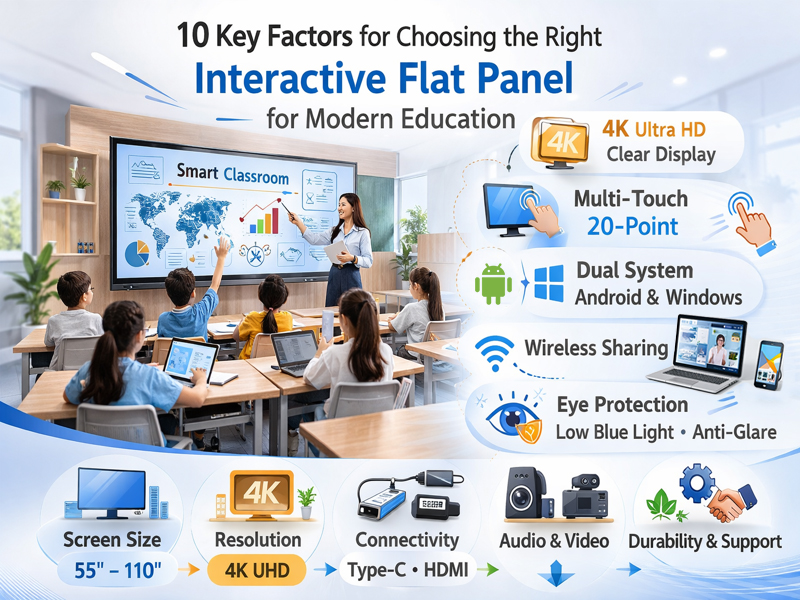
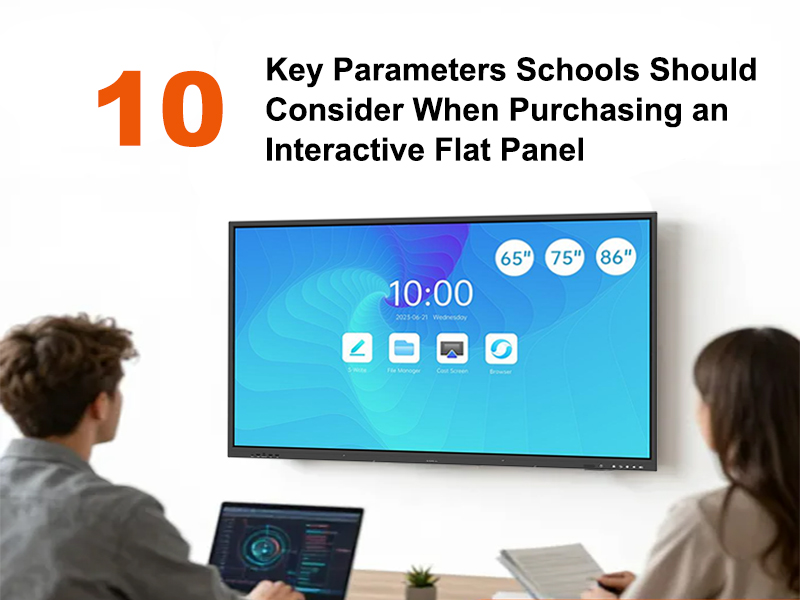
The size of the IFP should be matched with the area of the classroom and the number of students: 65-inch is suitable for small classrooms with less than 30 students such as tutoring classes and special education classrooms; 86-inch is the mainstream choice for regular classrooms with 30-50 students, balancing the viewing effect and space utilization; 98-inch or even larger size is more suitable for multi-functional halls, lecture halls and large classrooms.
In terms of resolution, 4K UHD (3840×2160) is the basic standard. It can present clear teaching content such as text, pictures and videos, and avoid blurring when zooming in on details, which is especially important for subjects such as mathematics, physics, chemistry and biology that involve complex graphs and formulas. At the same time, the display ratio of 16:9 is consistent with the mainstream teaching video and courseware format, ensuring no black edge and complete display.
Interactive experience is the core advantage of IFP, and touch performance directly affects teaching efficiency. For school scenarios, the IFP should support 20-point or even 40-point multi-touch to meet the needs of multi-student simultaneous interaction, group discussion and on-screen collaboration. The touch response time should be less than 5ms, and the effective recognition accuracy should be less than 5mm, realizing writing and operation without lag, which is equivalent to the experience of traditional blackboard writing and paper operation.
In addition, it is better to support multi-touch methods such as fingers, touch pens and non-transparent teaching aids, and realize gesture operations such as zooming, rotating and moving with one hand, which is convenient for teachers to operate while giving lectures without additional equipment.
Long-term viewing of the screen will bring visual burden to students, so eye protection is a key consideration for school IFP procurement. The qualified IFP must pass authoritative eye protection certifications such as TÜV Rheinland Flicker Free and Low Blue Light, eliminate screen flicker, reduce harmful blue light emission, and avoid students' eye fatigue, dryness and myopia caused by long-term classroom learning.
At the same time, the display panel should have a wide color gamut (≥100% sRGB is preferred) and a wide viewing angle (horizontal/vertical ≥175°), ensuring that students in any position of the classroom can see clear and true colors of the content, without color cast and dark corners.
School equipment is used frequently by multiple teachers and students, and even has the risk of accidental collision and scratch, so durability is the basic requirement. The IFP should adopt a full metal shell design, with no exposed internal wiring and no push-pull structure with easy wear, to ensure the stability of the overall structure. The screen surface is equipped with anti-scratch and anti-impact tempered glass (such as Corning Gorilla Glass), which can resist the scratch of teaching aids and the impact of accidental collision, and is easy to clean and maintain.
In addition, the whole machine should pass the 24h neutral salt spray test and high and low temperature aging test, which can adapt to the different environmental conditions of school classrooms and ensure long-term stable operation without failure. The modular design of functional components (such as speakers, cameras) is also a plus, which can be disassembled and maintained independently without opening the backboard, reducing the maintenance time and affecting teaching.
The embedded computing module (OPS computer) is the "brain" of the IFP, and its configuration directly determines the running speed and multi-task processing capability. For school teaching scenarios, the OPS computer should at least meet the standard of Intel Core i5 processor, 8GB RAM and 256GB SSD solid state drive. The i5 processor ensures smooth running of multiple teaching software at the same time; the large memory avoids lag caused by insufficient memory when opening large courseware and high-definition videos; the SSD solid state drive shortens the boot and software startup time, improving teaching efficiency.
In addition, the OPS module should support hot plug, which is convenient for later hardware upgrade and maintenance without professional disassembly, reducing the difficulty and cost of school equipment update.
Classroom teaching involves the connection of a variety of teaching equipment, so the IFP needs to have a rich interface to meet the diversified connection needs. It should be equipped with mainstream interfaces such as HDMI, USB 3.0, Type-C, VGA and RJ45 network port: HDMI and VGA are used to connect projectors, laptops and other display equipment; USB 3.0 and Type-C realize fast transmission of courseware data and connection of touch pens, wireless mouse and keyboard; RJ45 network port supports wired network access to ensure stable online teaching and resource downloading.
The Type-C interface with PD fast charging function is a bonus configuration, which can charge teachers' laptops and mobile phones, solving the problem of power shortage of mobile equipment in the classroom.
A complete teaching experience cannot be separated from the matching of audio and video functions. The IFP should be built-in with 2.2 channel high-power speakers (rated total power ≥60W) and array microphones, realizing clear sound playback and voice collection without additional external audio equipment. The array microphone supports long-distance voice pickup and noise reduction, which can clearly collect the teacher's lecture voice and the student's answer voice, and is suitable for interactive teaching and classroom recording.
The built-in high-definition camera (≥1080P) can meet the needs of online live teaching, remote interactive teaching and classroom video recording, and realize the integration of "display, interaction, recording and broadcasting", making the IFP a multi-functional teaching terminal.
The IFP must have good software and system compatibility to adapt to the diverse teaching software and teaching habits of schools. It should support mainstream operating systems such as Windows and Android, and realize one-key switching between systems: Android system is suitable for simple operations such as quick courseware playback, wireless projection and touch interaction; Windows system is compatible with all kinds of PC-based teaching software (such as PPT, WPS, professional drawing software and online education platforms), meeting the deep teaching needs of teachers.
In addition, it is better to pre-install professional education teaching software, with functions such as electronic whiteboard writing, courseware making, real-time annotation and classroom interaction, and support secondary development and customization to match the school's personalized teaching needs.
As a public institution, schools pay attention to energy conservation and environmental protection in equipment procurement, and the IFP must pass international authoritative energy saving and environmental protection certifications. ENERGY STAR 8.0 certification is the core standard for energy saving, which can effectively reduce the power consumption of the screen in standby and working state, and save the school's energy expenditure for a long time. At the same time, it should pass RoHS 2.0 environmental protection certification, without harmful substances such as lead and mercury, meeting the environmental protection requirements of school equipment and protecting the physical and mental health of teachers and students.
Gaoke's IFPs have passed a number of international certifications such as ENERGY STAR 8.0, RoHS 2.0 and CE, and are committed to providing green and low-carbon smart display solutions for global educational institutions.
The service life of school IFP is usually more than 5 years, so a perfect after-sales service and warranty system is the important guarantee for the long-term use of equipment. When purchasing, schools should pay attention to the official warranty period of the product (at least 3 years of whole machine warranty is preferred), and whether the manufacturer can provide on-site maintenance, 7×24h technical support and regular equipment debugging services.
It is crucial to choose a manufacturer with a global service network and professional after-sales team. Gaoke has set up branches and service points in many countries and regions around the world, with a professional after-sales engineer team, providing one-stop after-sales services such as on-site installation, debugging, maintenance and technical training for schools. At the same time, it provides customized project solutions and long-term technical support, solving the worries of school equipment use and maintenance.
Choosing a suitable interactive flat panel is the first step for schools to build a smart classroom. It is not only a simple purchase of a display device, but also a layout of smart education and teaching reform. The 10 parameters mentioned above cover the core performance, scene adaptation, durability and service guarantee of the IFP, and are the key basis for schools to make scientific procurement decisions.
Hangzhou Gaoke has been deeply engaged in the field of smart education display for more than 30 years, with a complete R&D, manufacturing and service system. Its IFP products are designed for the actual needs of school teaching, with international authoritative certifications, personalized customization capabilities and global after-sales service network. We have provided professional smart display solutions for thousands of educational institutions around the world, and helped the development of smart education with high-quality products and thoughtful services.
If you are looking for a reliable interactive flat panel supplier for smart classroom construction, Gaoke will be your best partner. We can provide customized solutions according to the different needs of your school's classroom size, teaching characteristics and budget, and escort the high-quality development of your school's education!
Hangzhou Gaoke Industry&Trade Co., Ltd.
· Global smart display solution provider
· 30+ years of R&D and manufacturing experience in education display equipment
· International certifications: TÜV, ENERGY STAR, RoHS, CE, ISO9001, etc.
· One-stop service: pre-sales design, in-sales construction, after-sales maintenance
· Global market coverage: Europe, Southeast Asia, the Middle East, South America and other regions

Hangzhou Gaoke Industry&trade Co., Ltd.


+8613706719639


A6 Cainiao Zhigu, Yuhang District, Hangzhou, Zhejiang, China




 中文
中文 English
 +86(571)89986945
 +8613706719639
 +8613706719639
 service@hz-gaoke.com
